So, your fan or blower arrives on site. Now what? Hopefully you’ve acquired the dimensional data and complete assembled weight, giving you the necessary data for preparing the foundation to which you will mount the fan assembly. The characteristics of the foundation you mount to can have a significant impact on the life of your fan or blower. The higher your vibration levels are, the shorter your life expectancy becomes for rotating components (i.e. wheel, shaft, bearings, couplings, sheaves, belts). To maximize the fan’s life expectancy, consider foundation characteristics such as: levelness, mass, support flexibility, & natural frequency.
As a rule of thumb, slab foundations should weigh at least three to four times more than the weight of your fan assembly to achieve a rigid mounting surface. In cases where a slab mount is not practical, the elevated or structural steel platform should be able to support the fan assembly’s weight while also preventing side sway.
A fan & blower can be mounted on either a rigid or flexible support. To be considered a rigid mount, the fan and support system should have a fundamental (lowest) natural frequency above the running speed. A flexibly mounted fan requires additional mounting considerations and will have a support system with a fundamental frequency below the running speed.
As with most generic advice, the previous information is based on general assumptions. If you are unsure which mounting characteristics are required for your specific application, it is best to consult with and/or use a fan & blower installation professional well versed in the dynamics of balance, alignment, and vibration analysis. Indventech provides these professional installation services to compliment our premier air movement products. Please contact our sales department at sales@indventech.com or (888) 864-4344.
Comments Off on FAN EFFICIENCY AND VOLUME CONTROLS
Selecting the correct industrial fan for your pneumatic system is critical to success. The more complex the air system, the more difficult selecting the correct industrial fan becomes. Add in the variable of multiple operators on a given pneumatic conveying system, and it becomes apparent that a safety factor for the fan efficiency to generate sufficient airflow is preferred. So how is this accomplished?
There are generally three methods to control your industrial fan’s volume output. Each has its advantage, however when thinking in terms of pure energy efficiency, there is a clear pecking order.
The First Method to Fan Efficiency
The first and typically cheapest to implement is an outlet damper, actuated manually, electrically, or pneumatically. While this usually represents the lowest capital cost of air volume control, it is also least efficient. That said, there are cases where outlet damper control is necessary for optimal system performance, regardless of fan efficiency.
The Second Method to Fan Efficiency
The second method involves the use of a damper on the intake side of the industrial fan. This can be done directly on the intake opening with an internal or external variable inlet vane (VIV) designed to pre-spin the air in the direction of wheel rotation, or through the use of an inlet box where a damper is mounted to the intake of this box with vanes set to pre-spin the air similarly to the VIV. These can also be actuated manually, electrically, or pneumatically. While this method has greater capital cost as compared to the discharge damper, the advantages include better system control and lower energy costs.
The Third Method to Fan Efficiency
The third method of volume control – operate the industrial fan motor with a variable frequency drive (VFD). With the cost of VFD’s becoming more reasonable, return on investment has improved. This method is the most energy efficient way to control your fan’s volume. It gives you full control of your fan’s potential.
To discuss which fan or control method is best for your application, contact Indventech at 888-864-4344 or email sales@indventech.com.
“I need more air!” I hear this a lot. Dust collection systems are just that, systems. A network of hoods, pipes, transitions, filters, fan, and various appurtenances. We understand this network and often find simple solutions. A simple evaluation can go a long way toward reducing/eliminating costly shortcomings in your system. Give us a call today and let’s talk about your system!
Did you know – we sell and service dust collectors, filters, fans, hose, duct, dampers, silencers, and many other parts to your system?
Keeping safety at the forefront of every job can be challenging when nothing bad has happened to you, your workers, or your company as a whole. Here is another example of tragedy, and a reminder that ALL of us should work safe, regardless of our track record. #safety
My daughter came to me last fall and asked for my help. She loves volleyball, wants to play college, but had run into a dead end athletically. Using my athletic and training background, I contemplated producing my own program, or finding a reasonable program already in place. I put her on a detailed jump program. She’s gained 9.5 inches in vertical in 9 months and is still working through it. Here are the links – if you have a son or daughter looking for big jumping gains, this works. Click here to jump!
Special thanks to Americraft for featuring our very own Keenan White in their quarterly Rep Spotlight!
Here’s the excerpt from their newsletter for you to get to know a bit about Keenan:
“We plan to have at least one article every issue that introduces and highlights one of our extraordinary partners and reps. We can think of no one better to launch this feature than to share with everyone our very own, extraordinary, Keenan White.
Keenan was born in South Carolina and raised in Wisconsin. He attended college at the University of Wisconsin-Stevens Point, where he secured his degree in Business and Entrepreneurship. After initially ‘dabbling’ in the fan industry, he soon found himself working for the fan company his brother helped start. After seven years with them he moved back to his birthplace, South Carolina, to work as a manufacturer’s representative for another company. After another 2 years, his entrepreneurial spirit emerged, so he started Indventech in 2009. According to Keenan, initially he was only involved in selling fans, but soon he found himself immersed in the wider ‘air movement’ industry. He decided that, in order to satisfy customer needs, he need to become the ‘go to’ subject matter expert; supplying products AND services related to industrial air movement.
Today, Indventech supplies fans, blowers, dust collectors; basically anything and everything that involves air movement. He found his niche by filling a need for a dependable, knowledgeable resource to his customers. To quote Keenan, he ‘doesn’t come from the angle that all of his customers need fans, they need a consultant that may come in and diagnose their problem and find the best solution for them.’ He builds relationships with his clients knowing he may not sell a fan to them initially, but when they do need something in the future, they call him and at some point it may develop into a sale. When asked what contributes to his success, Keenan stated ‘I do what I say I’m going to do. I ask questions and listen. If you do that, particularly listen, then you can provide the right solutions.’
Another key to Keenan’s success is to limit the scope and target of his client base. He won’t try to ‘compete with the poultry fans or the Grainger fans.’ He goes after the people that want the ‘big guns’ like Twin Cities fans. Keenan stated, ‘I am not talking about customers who want cheap sheet metal fans where there are no pressure capabilities; just blowing air around like Shaeffer or J&D. There are always cheaper ways to move air around than Americraft fans. But what I show the customer is how they are going to get a bigger bang for their buck. I am thinking heavier duties. I push the envelope with performance and can do different things with props that can do different performance. If there is a performance condition the Americraft catalog doesn’t meet, I call Americraft and we discuss what we can do. That’s where working with a small company is beneficial. Initially it’s easy to think of Americraft of what’s in the catalog, but if you think differently and outside the box, you will find you can satisfy customers needs better.’
Keenan also further attributes his success to accessing the decision maker. He says if you are really concerned about solving problems, get to the plant or the maintenance engineer. Keenan went onto say ‘You have to be in the mindset that you are a problem solver.’ He says he gets on the company’s website and looks to see who the plant or maintenance engineer is. If he can’t find it, he calls and asks who these people are. He said if he can’t find it through a phone call, he sometimes will go to the property and will start looking and asking around. He stated, ‘You may have to go to the facility, find the names, and let them know you solve air movement issues. If they won’t talk to me then, I leave my card and my information with them and then follow up with phone calls.’ Keenan says when he is out driving around, he always looks at the potential client’s facilities. ‘If I see pipes and smoke, I stop!’
In his personal life, Keenan has been married for 18 years and has two daughters. He works very hard to have work/
life balance. He went onto say, ‘I spend all my free time with immediate family. I am currently coaching my daughter in volleyball to help her with her collegiate aspirations. Once my girls are out of the house, I will revert to golf and fishing. I love the outdoors… and various brews of Scotch Ale!’
Thanks Keenan, and keep doing what you are doing!”
And thank you, Americraft, for all you do to build great products and trustworthy relationships with air movement suppliers!


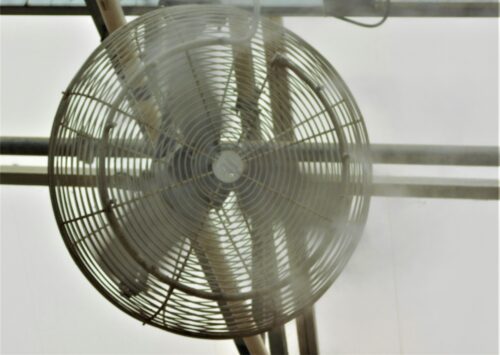 So, your fan or blower arrives on site. Now what? Hopefully you’ve acquired the dimensional data and complete assembled weight, giving you the necessary data for preparing the foundation to which you will mount the fan assembly. The characteristics of the foundation you mount to can have a significant impact on the life of your fan or blower. The higher your vibration levels are, the shorter your life expectancy becomes for rotating components (i.e. wheel, shaft, bearings, couplings, sheaves, belts). To maximize the fan’s life expectancy, consider foundation characteristics such as: levelness, mass, support flexibility, & natural frequency.
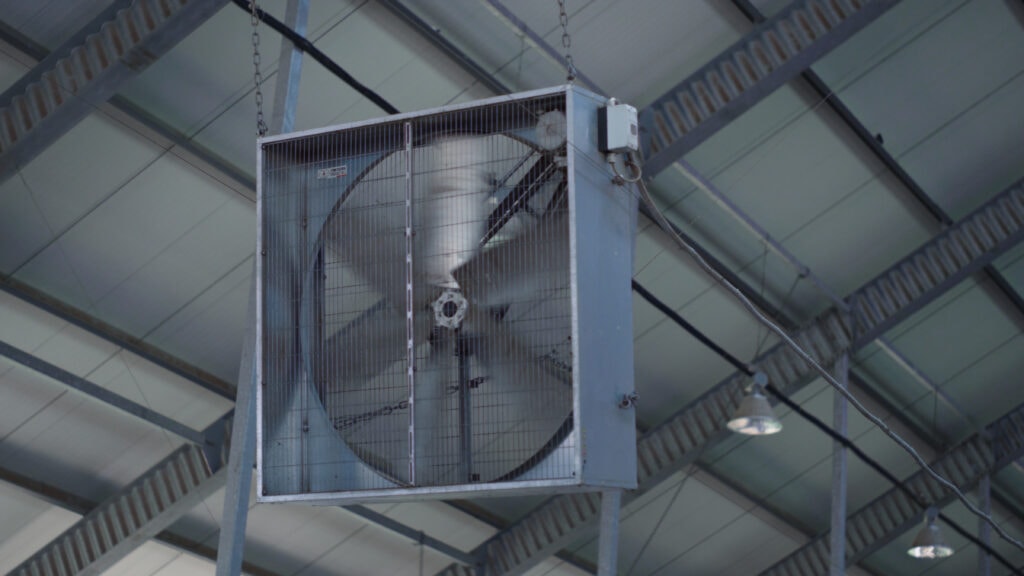 Selecting the correct industrial fan for your pneumatic system is critical to success. The more complex the air system, the more difficult selecting the correct industrial fan becomes. Add in the variable of multiple operators on a given pneumatic conveying system, and it becomes apparent that a safety factor for the fan efficiency to generate sufficient airflow is preferred. So how is this accomplished?
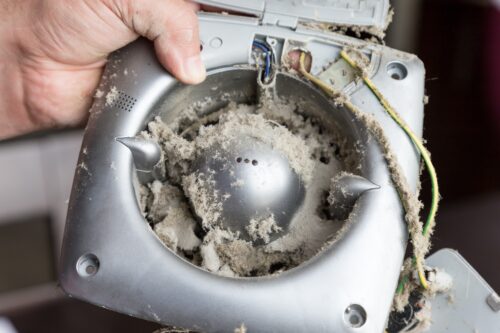 “I need more air!” I hear this a lot. Dust collection systems are just that, systems. A network of hoods, pipes, transitions, filters, fan, and various appurtenances. We understand this network and often find simple solutions. A simple evaluation can go a long way toward reducing/eliminating costly shortcomings in your system. Give us a